Sunday, October 14, 2012

SMALLER LOVE HATH NO MAN THAN OBAMA'S, THAN TO LAY DOWN HIS "FRIEND" FOR A COUPLE OF POINTS IN OHIO


!!!!

Mark Steyn: 'Politicized' Benghazi distracts from Big Bird

The first successful terrorist attack on U.S. sovereign territory since 9/11, and on the very anniversary and by al-Qaida-linked killers, was not helpful to the Obama team.


By MARK STEYN / Syndicated Columnist


"The entire reason that this has become the political topic it is, is because of Mitt Romney and Paul Ryan."


Thus, Stephanie Cutter, President Obama's deputy campaign manager, speaking on CNN about an armed attack on the 9/11 anniversary that left a U.S. consulate a smoking ruin and killed four diplomatic staff, including the first American ambassador to be murdered in a third of a century. To discuss this event is apparently to "politicize" it and to distract from the real issues the American people are concerned about. 

 For example, Obama spokesperson Jen Psaki, speaking on board Air Force One on Thursday:


Article Tab: Vice President Joe Biden smiles during the vice presidential debate at Centre College, Oct. 11, in Danville, Ky.
Vice President Joe Biden smirks during the vice presidential debate at Centre College, Oct. 11, in Danville, Ky.
GETTY IMAGES

"There's only one candidate in this race who is going to continue to fight for Big Bird and Elmo, and he is riding on this plane."


She's right! The United States is the first nation in history whose democracy has evolved to the point where its leader is provided with a wide-body transatlantic jet in order to campaign on the vital issue of public funding for sock puppets. Sure, Caligula put his horse in the Senate, but it was a real horse. At Ohio State University, the rapper will.i.am introduced the President by playing the Sesame Street theme tune, which, oddly enough, seems more apt presidential walk-on music for the Obama era than "Hail To The Chief.


Obviously, Miss Cutter is right: A healthy mature democracy should spend its quadrennial election on critical issues like the Republican Party's war on puppets rather than attempting to "politicize" the debate by dragging in stuff like foreign policy, national security, the economy and other obscure peripheral subjects. But, alas, it was her boss who chose to "politicize" a security fiasco and national humiliation in Benghazi. 


At 8.30 p.m., when Ambassador Stevens strolled outside the gate and bid his Turkish guest good night, the streets were calm and quiet. At 9.40 p.m., an armed assault on the compound began, well-planned and executed by men not only armed with mortars but capable of firing them to lethal purpose – a rare combination among the excitable mobs of the Middle East. There was no demonstration against an Islamophobic movie that just got a little out of hand. Indeed, there was no movie protest at all. Instead, a U.S. consulate was destroyed and four of its personnel were murdered in one of the most sophisticated military attacks ever launched at a diplomatic facility.


This was confirmed by testimony to Congress a few days ago, although you could have read as much in my column of four weeks ago. Nevertheless, for most of those four weeks, the President of the United States, the Secretary of State, the U.S. Ambassador to the United Nations and others have persistently attributed the Benghazi debacle to an obscure YouTube video – even though they knew that the two events had nothing to do with each other by no later than the crack of dawn Eastern time on Sept. 12, by which point the consulate's survivors had landed safely in Tripoli.


To "politicize" means "to give a political character to." It is a reductive term, capturing the peculiarly shrunken horizons of politics: "Gee, they nuked Israel. D'you think that will hurt us in Florida?" So media outlets fret that Benghazi could be "bad" for Obama – by which they mean he might be hitting the six-figure lecture circuit four years ahead of schedule. 


But for Chris Stevens, Sean Smith, Glen Doherty and Tyrone Woods, it's real bad. They're dead, over, gonesville. Given that Obama and Secretary Clinton refer to Stevens pneumatically as "Chris," as if they've known him since third grade, why would they dishonor the sacrifice of their close personal friend by peddling an utterly false narrative as to why he died? You want "politicization"? Secretary Clinton linked the YouTube video to the murder of her colleagues even as the four caskets lay alongside her at Andrews Air Force Base – even though she had known for days that it had nothing to do with it. It's weird enough that politicians now give campaign speeches to returning coffins. But to conscript your "friend's" corpse as a straight man for some third-rate electoral opportunism is surely as shriveled and worthless as "politicization" gets.


In the vice-presidential debate, asked why the White House spent weeks falsely blaming it on the video, Joe Biden took time off between big toothy smirks to reply: "Because that was exactly what we were told by the intelligence community." That, too, is false. He also denied that the government of which he is nominally second-in-command had ever received a request for additional security. At the risk of "politicizing" things, this statement would appear also to be untrue.


Instead, the State Department outsourced security for the Benghazi consulate to Blue Mountain, a Welsh firm that hires ex-British and Commonwealth Special Forces, among the toughest hombres on the planet. The company's very name comes from the poem "The Golden Journey To Samarkand," whose words famously adorn the regimental headquarters of Britain's Special Air Service in Hereford. Unfortunately, the one-year contract for consulate security was only $387,413 – or less than the cost of deploying a single U.S. soldier overseas. On that budget, you can't really afford to fly in a lot of crack SAS killing machines, and have to make do with the neighborhood talent pool. 


So who's available? Blue Mountain hired five members of the Benghazi branch of the February 17th Martyrs' Brigade and equipped them with handcuffs and batons. A baton is very useful when someone is firing an RPG at you, at least if you play a little baseball. There were supposed to be four men heavily armed with handcuffs on duty that night, but, the date of Sept. 11 having no particular significance in the Muslim world, only two guards were actually on shift.


Let's pause right there, and "politicize" a little more. Liberals are always going on about the evils of "outsourcing" and "offshoring" – selfish vulture capitalists like Mitt Romney shipping jobs to cheap labor overseas just to save a few bucks. How unpatriotic can you get! So now the United States government is outsourcing embassy security to cheap Welshmen who, in turn, outsource it to cheaper Libyans. Diplomatic facilities are U.S. sovereign territory – no different de jure from Fifth Avenue or Mount Rushmore. So defending them is one of the core responsibilities of the state. 


But that's the funny thing about Big Government: the bigger it gets, the more of life it swallows up, the worse it gets at those very few things it's supposed to be doing. So, on the first anniversary of 9/11 in a post-revolutionary city in which Western diplomats had been steadily targeted over the previous six months, the government of the supposedly most powerful nation on Earth entrusted its security to Abdulaziz Majbari, 29, and his pal, who report to some bloke back in Carmarthen, Wales.


In the days before the attack, Joe Biden had been peddling his Obama campaign slogan that: "Bin Laden is dead, and General Motors is alive." The first successful terrorist attack on U.S. sovereign territory since 9/11, and on the very anniversary and by al-Qaida-linked killers, was not helpful to the Obama team. And so the nature of the event had to be "politicized": Look, over there – an Islamophobic movie! "Greater love hath no man than this," quoth the President at Chris Stevens' coffin, "that a man lay down his life for his friends." Smaller love hath no man than Obama's, than to lay down his "friend" for a couple of points in Ohio.


©MARK STEYN

YOU KNOW THAT THERE IS TRULY HOPE WHEN THE WASHINGTON POST AND NEWSWEEK WRITE NEGATIVELY ABOUT BARACK HUSSEIN OBAMA

!!!!


The liberal media bashing Obama!  Now this is a story!!!!.
 Take a few minutes to read this -- Subject:  Washington Post and Newsweek hit Obama
Description: cid:1.929455751@web182202.mail.bf1.yahoo.com
THE   WASHINGTON POST HITS OBAMA

Finally, the Washington Post and Newsweek speak out about Obama. This is timely
and tough. As many of you know, the Washington Post and Newsweek have a reputation
for being extremely liberal. The fact that their editors saw fit to print
the following article about Obama and the one that appears in the latest Newsweek, makes this a truly amazing event,
and a news story in and of itself. At last, the truth about our
President and his agenda are starting to trickle through the
"protective wall" built around him by the liberal media.

___________________________
I Too Have Become Disillusioned.

By Matt Patterson (columnist - Washington Post, New York Post, San
Francisco Examiner)

Years from now, historians may regard the 2008 election of Barack
Obama as an inscrutable and disturbing phenomenon, the result of a
baffling breed of mass hysteria akin perhaps to the witch craze of the
Middle Ages. How, they will wonder, did a man so devoid of
professional accomplishment beguile so many into thinking he could
manage the world's largest economy, direct the world's most powerful
military, execute the world's most consequential job?

Imagine a future historian examining Obama's pre-presidential life:
ushered into and through the Ivy League, despite unremarkable grades
and test scores along the way; a cushy non-job as a "community
organizer;" a brief career as a state legislator devoid of legislative
achievement (and in fact nearly devoid of his attention, so often did
he vote "present"); and finally an unaccomplished single term in the
United States Senate, the entirety of which was devoted to his
presidential ambitions.

He left no academic legacy in academia, authored no signature
legislation as a legislator. And then there is the matter of his
troubling associations: the white-hating, America-loathing preacher
who for decades served as Obama's "spiritual mentor"; a real-life,
actual terrorist who served as Obama's colleague and political
sponsor. It is easy to imagine a future historian looking at it all
and asking: how on Earth was such a man elected president?

Not content to wait for history, the incomparable Norman Podhoretz
addressed the question recently in the Wall Street Journal: To be
sure, no white candidate who had close associations with an outspoken
hater of America like Jeremiah Wright and an unrepentant terrorist
like Bill Ayers, would have lasted a single day. But because Mr. Obama
was black, and therefore entitled in the eyes of liberal Dom to have
hung out with protesters against various American injustices, even if
they were a bit extreme, he was given a pass. Let that sink in: Obama
was given a pass - held to a lower standard - because of the color of
his skin.

Podhoretz continues: And in any case, what did such ancient history
matter when he was also so articulate and elegant and (as he himself
had said) "non-threatening," all of which gave him a fighting chance
to become the first black president and thereby to lay the curse of
racism to rest?

Podhoretz puts his finger, I think, on the animating pulse of the
Obama phenomenon - affirmative action. Not in the legal sense, of
course. But certainly in the motivating sentiment behind all
affirmative action laws and regulations, which are designed primarily
to make white people, and especially white liberals, feel good about
themselves.

Unfortunately, minorities often suffer so that whites can pat
themselves on the back. Liberals routinely admit minorities to schools
for which they are not qualified, yet take no responsibility for the
inevitable poor performance and high drop-out rates which follow.
Liberals don't care if these minority students fail; liberals aren't
around to witness the emotional devastation and deflated self-esteem
resulting from the racist policy that is affirmative action. Yes,
racist. Holding someone to a separate standard merely because of the
color of his skin - that's affirmative action in a nutshell, and if
that isn't racism, then nothing is.

And that is what America did to Obama. True, Obama himself was never
troubled by his lack of achievements, but why would he be? As many
have noted, Obama was told he was good enough for Columbia   despite
undistinguished grades at Occidental; he was told he was good enough
for the US Senate despite a mediocre record in Illinois ; he was told
he was good enough to be president despite no record at all in the
Senate. All his life, every step of the way, Obama was told he was
good enough for the next step, in spite of ample evidence to the
contrary.

What could this breed if not the sort of empty narcissism on display
every time Obama speaks? In 2008, many who agreed that he lacked
executive qualifications nonetheless raved about Obama's oratory
skills, intellect, and cool character. Those people - conservatives
included - ought now to be deeply embarrassed.

The man thinks and speaks in the hoariest of clichés, and that's when
he has his Teleprompters in front of him; when the prompter is absent
he can barely think or speak at all. Not one original idea has ever
issued from his mouth - it's all warmed-over Marxism of the kind that
has failed over and over again for 100 years.

And what about his character? Obama is constantly blaming anything and
everything else for his troubles. Bush did it; it was bad luck; I
inherited this mess. Remember, he wanted the job, campaigned for the
task. It is embarrassing to see a president so willing to advertise
his own powerlessness, so comfortable with his own incompetence. But
really, what were we to expect? The man has never been responsible for
anything, so how do we expect him to act responsibly?

In short: our president is a small-minded man, with neither the
temperament nor the intellect to handle his job. When you understand
that, and only when you understand that, will the current erosion of
liberty and prosperity make sense. It could not have gone otherwise
with such a man in the Oval Office


Steven Morrison

Wednesday, October 10, 2012

THERE ARE LITTLE LIES, THERE ARE BIG LIES, AND THEN THERE ARE DAMN LIES

!!!!

WND EXCLUSIVE

Obama's ring: 'There is no god but Allah'

He's worn band on wedding-ring finger since before he met Michelle

S


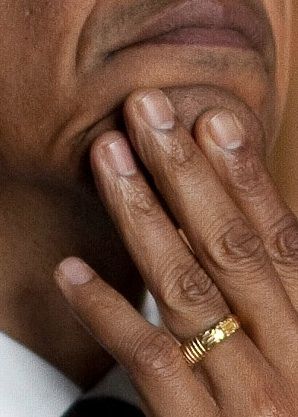
Barack Obama's gold band
NEW YORK – As a student at Harvard Law School, then-bachelor Barack Obama’s practice of wearing a gold band on his wedding-ring finger puzzled his colleagues.
Now, newly published photographs of Obama from the 1980s show that the ring Obama wore on his wedding-ring finger as an unmarried student is the same ring Michelle Robinson put on his finger at the couple’s wedding ceremony in 1992.
Moreover, according to Arabic-language and Islamic experts, the ring Obama has been wearing for more than 30 years is adorned with the first part of the Islamic declaration of faith, the Shahada: “There is no god except Allah.”

Inscription on Obama's ring
The Shahada is the first of the Five Pillars of Islam, expressing the two fundamental beliefs that make a person a Muslim: There is no god but Allah, and Muhammad is Allah’s prophet.
Sincere recitation of the Shahada is the sole requirement for becoming a Muslim, as it expresses a person’s rejection of all other gods.
Egyptian-born Islamic scholar Mark A. Gabriel, Ph.D., examined photographs of Obama’s ring at WND’s request and concluded that the first half of the Shahada is inscribed on it.
“There can be no doubt that someone wearing the inscription ‘There is no god except Allah’ has a very close connection to Islamic beliefs, the Islamic religion and Islamic society to which this statement is so strongly attached,” Gabriel told WND.
Jerome Corsi’s “Where’s the REAL Birth Certificate?” carefully documents the story the establishment media still refuses to tell
“Dreams from My Real Father” producer Joel Gilbert, an Arabic speaker and an expert on the Middle East, was the first to conclude that Obama’s ring, reportedly from Indonesia, bore an Islamic inscription.
Photographs published last week by the New Yorker from Obama’s time at Occidental College, taken by fellows students, indicate that the ring Obama wore three decades ago is the one he is wearing in the White House.

Barack Obama
As WND reported in July, previously published photos have shown Obama wearing a gold band on his wedding-ring finger continuously from 1981 at Occidental, through graduation at Columbia in 1983, in a visit to Africa in 1988 and during his time at Harvard from 1988 to 1991. But none, until now, have displayed the ring with enough detail to identify it as the one he currently is wearing.
WND reported a satirical edition of the Harvard Law Review published by students in 1990 contains a mock Dewers Scotch profile advertisement poking fun at Obama. Among a list of Obama’s “Latest Accomplishments” is: “Deflecting Persistent Questioning About Ring On Left Hand.”
The comment suggests the ring was a subject of student curiosity at the time and that Obama was not forthcoming with an explanation.
He still has not explained why he wore the band on his wedding-ring finger before he married Michelle.
Declaration
Gabriel, born to Muslim parents in Upper Egypt, grew up immersed in Islamic culture. He memorized the Quran at age of 12 and graduated in 1990 with a Masters degree from the prestigious Al-Azhar University in Cairo, the pre-eminent Sunni Muslim institution of learning.
He explained that on Obama’s ring, the declaration “There is no god except Allah” (La Ilaha Illallah) is inscribed in two sections, one above the other.
On the upper section, “There is no god” is written in Arabic letters, from right to left: Lam, Alif, Alif, Lam, Ha.
On the lower section is “except god,” written in Arabic letters from right to left: Alif, Lam, Alif, Alif, Lam, Lam, Ha.
In the lower section, the word “Allah” is written partially on top of the word “except,” noted Gabriel, the author of “Islam and Terrorism” and “Journey Inside the Mind of an Islamic Terrorist.”
It is common in Islamic art and Arabic calligraphy, especially when expressing Quranic messages on jewelry, to artfully place letters on top of each other to fit them into the allotted space.
The exhibit below shows how the Arabic inscription fits over the two parts of the Obama ring.

“There is no God except Allah” overlaid on Obama ring
‘First-rate accent’
In an interview during the 2008 presidential campaign, New York Times columnist Nicholas Kristof questioned Obama about his Islamic education in Indonesia, where he lived from 1967 to 1971.
After acknowledging that he once got in trouble for making faces during Quran study classes in his elementary school, Obama recited for Kristoff the opening lines of the Arabic call to prayer, the Adhan.
The prayer incorporates the Shahada, the expression of Islamic faith, with each line repeated twice:
Allah is supreme! Allah is supreme!
I witness that there is no god but Allah
I witness that Muhammad is his prophet
Kristof noted Obama recited the prayer in Arabic “with a first-rate accent.”
“In a remark that seemed delightfully uncalculated (it’ll give Alabama voters heart attacks), Mr. Obama described the call to prayer as ‘one of the prettiest sounds on Earth at sunset,’” Kristoff wrote.
Gabriel told WND that a person wearing a ring with “There is no god except Allah” demonstrates the significance of Islam in his life.
“Christians never use the statement,” he pointed out. “By wearing the Shahada on jewelry, a person communicates that Allah is in control of all circumstances. Allah controls you; Allah is the one and only one.”
Obama, who attended Rev. Jeremiah Wright’s Trinity United Church of Christ in Chicago for two decades, has repeatedly insisted he is a Christian.

Obama's hand in a White House photo
‘Blessed statement in Islam’
Gabriel emphasized the importance of the Shahada in the profession of faith in Islam.
“Muslims recite the Shahada when they wake up in the morning and before they go to sleep at night,” he said. “It is repeated five times every day in the call to prayer in every mosque. A single honest recitation of the Shahada in Arabic is all that is required for a person to convert to Islam.”
Gabriel believes it would be impossible for Obama not to be aware of what is written on the ring, calling it a “blessed statement in Islam.”
“By wearing this religious statement on one’s hand, it connects the person to Islam,” he said. “It is worn in hopes that Allah’s protections would be with the person, in hopes of gaining favor with Allah.”
He affirmed that Muslim men do wear gold rings, despite prohibitions in Islamic law.
“Though Islamic law prohibits the wearing of gold jewelry by men, it is a widely accepted custom, even in strictly Muslim countries,” he said. “The wearing of gold rings is even more acceptable when it contains a religious message, such as ‘There is no god except Allah.’”
He noted there is also widespread acceptance of men wearing gold jewelry in non-Arab Islamic societies such as Indonesia, Bangladesh, Malaysia and Pakistan, where Muslims generally understand that Muslims are subject to strong influences of local non-Arab cultures.
“Therefore, even though technically prohibited, a Muslim man wearing a gold ring is not looked down upon, especially if the jewelry reflects a love of Islam and a connection to Islamic society,” he said. “An even greater level of acceptance is for businessmen who deal with infidels, because such a person would be regarded as a person of influence.”

Obama signing legislation (White House photo)
‘I have known Islam on three continents’
Filmmaker Joel Gilbert, an expert on Islamic history, noted Obama wore the ring during his high-profile speech in Cairo on June 4, 2009, in the first months of his presidency.
“Now we have a new context for what Obama meant when he told the Islamic audience in Cairo that he has ‘known Islam on three continents,” Gilbert said. “He also told the Cairo audience that he considered it part of his responsibility as president of the United States ‘to fight against negative stereotypes of Islam wherever they appear.’ All religious Muslims are by definition required to defend Islam.”
Gilbert’s most recent documentary films on the Middle East are “Farewell Israel: Bush, Iran and The Revolt of Islam” and “Atomic Jihad: Ahmadinejad’s Coming War and Obama’s Politics of Defeat”

Obama in Cairo, Egypt, June 4, 2009

Obama in Cairo, Egypt, June 4, 2009, close-up
The Occidental ring
The photographs published last week by New Yorker magazine indicate Obama was wearing the ring at Occidental College.
One photo shows Obama sitting alongside Occidental roommate Hasan Chandoo in 1981, apparently waiting for a meal to be served.

Barack Obama and roommate Hasan Chandoo at Occidental College in 1981 (Tom Grauman, New Yorker magazine)
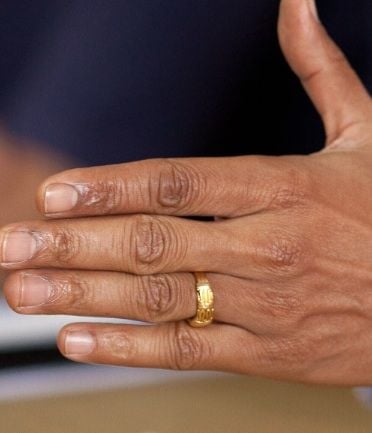
Obama’s extended left hand clearly shows the ring, as seen below.

(Tom Grauman, New Yorker magazine)
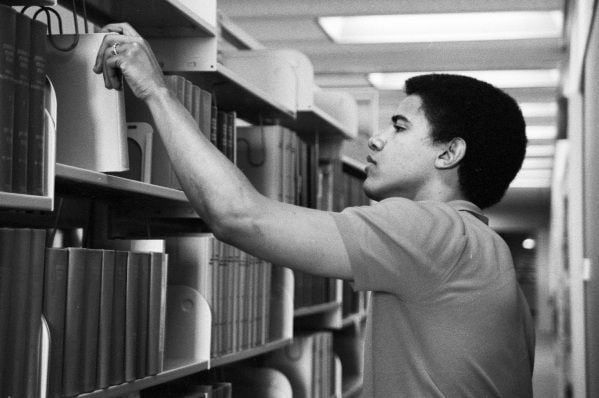
The second of the recently released photos shows Obama reaching for a book from an Occidental College library shelf.

Barack Obama in Occidental College library in 1981 (Tom Grauman, New Yorker magazine)
A close-up of the library photo can be seen below.

Detail of Barack Obama ring in Occidental College library in 1981 (Tom Grauman, New Yorker magazine)
In the above photo, the ring’s design can be seen, including a series of parallel bars that distinguish its outer circumference.
The Obama wedding ring
The ring was mentioned in a New York Times article in 2009 recounting the Obamas’ wedding.
In the story, Jodi Kantor described its “intricate gold design,” noting it came from Barack Obama’s boyhood home of Indonesia and was not traditional, like Michelle’s.
Kantor wrote:
Just before the Rev. Jeremiah A. Wright Jr. pronounced Barack Obama and Michelle Robinson man and wife on the evening of Oct. 3, 1992, he held their wedding rings – signifying their new, enduring bonds – before the guests at Trinity United Church of Christ. Michelle’s was traditional, but Barack’s was an intricate gold design from Indonesia, where he had lived as a boy.
There was no mention in the article that Obama already had been wearing the ring for more than a decade.
The photos of the ring from the 1980s can be compared with more recent photos, such as the ones published by the Huffington Post in 2010 in an article by Anya Strzemien, “Obama’s ‘Intricate’ Indonesian Wedding Band: A CLOSE-UP,” seen here.

Obama wedding ring, Huffington Post, March 18, 2010

Obama wedding ring, Huffington Post, March 18, 2010
Note: Jerome Corsi is available to discuss this story with media.

Tuesday, October 9, 2012

BIG BIRD LIVES IN THE MIDST OF A BUNCH OF FAT CATS

!!!!


sesame-street-big-bird.jpg


THE CORNER
NATIONAL REVIEW ONLINE


President Obama, who has railed against the “fat-cat bankers on Wall Street” and the wealthy, has been an eager defender of Big Bird and public broadcasting this week in light of Mitt Romney’s comments that he would defund it in last week’s debate. 

But it turns out that many of those behind Big Bird are actually members of the 1 percent themselves (anyone with a total income of $343,927 or more as of 2009), based on their salaries.


At Corporation for Public Broadcasting, according to the CPB’s 2011 tax forms:
Patricia De Stacy Harrison, president and CEO $361,895
At PBS, according to 2011 tax forms:
Paula Kerger, president and CEO $669,260
Michael Jones,  chief operating officer $477,296
Barbara Landes, chief financial officer, treasurer, and senior vice president $402,355
Katherine Lauderdale, senior vice president and general counsel,  $381,855.
At Sesame Workshop, according to 2011 tax forms:
Gary Knell, president and CEO of Sesame Workshop until October 2011, $988,456
H. Melvin Ming, current president and CEO, $584,572
Lewis Bernstein $406,387
Terry Fitzpatrick $439,741
Myung Kang-Huneke $389,005
Sherrie Westin $463,892
Susan Kolar $401,425
Miranda Barry $397,175
Maura Regan $379,733
Joseph Mazzarino $556,165
Caralynn Sandorf $354,476
Anita Stewart $455,369

And while the actor who plays Big Bird (Carroll Spinney) doesn’t have a salary that puts him in the 1 percent, he’s not far off: Spinney makes $314,072.


And who’s funding this? Well, in part, taxpayers: the federal government gave the CPB a grant of $444.1 million in 2012. 

Monday, October 8, 2012

OBAMA LOST THE FIRST DEBATE PRIMARILY BECAUSE HE HAS BEEN A BAD PRESIDENT

!!!!


WAS OBAMA REALLY THAT BAD IN THE DEBATE?

BY JOHN PODHORETZ

http://www.commentarymagazine.com/2012/10/08/was-obama-really-that-bad-in-the-debate/

October 8, 2012     


This week’s “Saturday Night Live” had a sketch portraying “Day 3″ of MSNBC’s coverage of “the worst thing that has ever happened anywhere”—the debate on Wednesday night. This brilliant bit of parody [  http://www.nbc.com/saturday-night-live/video/msnbc-debate-fallout/1419929/http://www.nbc.com/saturday-night-live/video/msnbc-debate-fallout/1419929/  ] (no, my wife doesn’t work there any longer, so this does not require a disclaimer) captured one of the strangest aspects of the liberal response to Barack Obama’s performance: The masochistic insistence on going over and over and over just how bad and awful and terrible Obama was.
 

But was Obama really that terrible? The argument he was rests on the presumption that he failed to make his case and failed to call Romney out. He did fail at those, but as Yuval Levin argues in today’s must-read blog post, that may be due more to the fact that he doesn’t have a case to make and can’t call Romney out so easily; he’s spent the year running against a caricature of Mitt Romney, not on the grounds that he has a positive agenda for a second term. Romney did not let Obama’s distorted descriptions of his policies go unchallenged, and Obama’s inability to come back at Romney is in part the result that all Obama has are allegations, not substantial criticisms.
 

There’s a reason why Democrats, liberals, and Obama camp followers are concentrating on the debate. They want to isolate it, scapegoat it, and push it over the cliff. They want to say it was a bad night, an off night, a misfire, a lousy game…because anybody can have one of those.
This inadvertently hilarious New York Times story this morning lays out the apologists’s explanation: “Mr. Obama does not like debates to begin with, aides have long said, viewing them as media-driven gamesmanship….Mr. Obama made clear to advisers that he was not happy about debating Mr. Romney, whom he views with disdain. It was something to endure, rather than an opportunity, aides said.”

On the face of it, this is absurd: If he views Romney with disdain, why wouldn’t he relish the opportunity to crush him in a debate? Debates aren’t dates or dinner parties or business meetings; they are contests, and Obama is a very competitive person. Why would he only “endure” one, given how utterly wonderful he is? As for “media-driven gamesmanship,” what does Obama call going on David Letterman’s show, or Jay Leno’s, both of which he seems to enjoy mightily?
 

Oh, and don’t forget that “Obama’s debate preparations were hindered by his day job, his practice sessions often canceled or truncated because of events.” Yeah, because Romney wasn’t at all busy in the weeks leading up to it.
 

But, see, now Obama has seen the game films. Now he knows where he went wrong. Now he can come back strong. That’s the comforting thing about focusing on Obama‘s performance. A performance can change. Don’t forget, Ronald Reagan had a bad first debate in 1984 and a great second debate and won by 20 points.
 

Well, yes, Reagan did, but the economy was creating a million jobs a month and growing at an annual rate of 9 percent that year. Walter Mondale wasn’t going to win that election unless Reagan coded on stage during the second debate. What are the comparable national conditions that call for an Obama reelection? That the unemployment rate is now where it was when he took office four months after Lehman collapsed? That three-fifths of the electorate says the country is on the wrong track?
 

Obama can do better in the next debate, to be sure…but how? By calling Romney a liar? Does the Obama team think Romney will have no effective response to that accusation in the next two debates? The desperate way Obama and his team are harping on Romney saying he wants to cut funding for public broadcasting shows the condition in which they find themselves. Is his case for reelection that he wants to save Big Bird?
 

The president didn’t lose the debate on Wednesday because he performed badly on Wednesday. He didn’t perform well, to be sure, but others have done much worse with less fallout.
He lost the debate because he’s been a bad president.

Saturday, October 6, 2012

BIG BIRD, FLY ME TO THE MOON ON AIRFORCE ONE

!!!!

Mark Steyn: Will Big Bird ever leave the government nest?

If Sesame Street is not commercially viable, then nothing is, and we should just cut to the chase and bail out everything.


By MARK STEYN
Syndicated columnist


Apparently, Frank Sinatra served as Mitt Romney's debate coach. As he put it about halfway through "That's Life":
"I'd jump right on a big bird and then I'd fly ... ."


Article Tab: This Aug. 30, 2009, file photo shows Big Bird, of the children's television show Sesame Street, in Los Angeles.
 
 
This Aug. 30, 2009, file photo shows Big Bird, of the children's television show Sesame Street, ASSOCIATED PRESS FILE PHOTO

That's what Mitt did in Denver. Ten minutes in, he jumped right on Big Bird, and then he took off – and never looked back, while the other fellow, whose name escapes me, never got out of the gate. 


It takes a certain panache to clobber not just your opponent but also the moderator. Yet that's what the killer Mormon did when he declared that he wasn't going to borrow money from China to pay for Jim Lehrer and Big Bird on PBS. It was a terrific alpha-male moment, not just in that it rattled Lehrer, who seemed too preoccupied contemplating a future reading the hog prices on the WZZZ Farm Report to regain his grip on the usual absurd format, but in the sense that it indicated a man entirely at ease with himself – in contrast to wossname, the listless sourpuss staring at his shoes


Yet, amidst the otherwise total wreckage of their guy's performance, the Democrats seemed to think that Mitt's assault on Sesame Street was a misstep from whose tattered and ruined puppet-stuffing some hay is to be made. "WOW!!! No PBS!!! WTF how about cutting congress's stuff leave big bird alone," tweeted Whoopi Goldberg. 


Even the president mocked Romney for "finally getting tough on Big Bird" – not in the debate, of course, where such dazzling twinkle-toed repartee might have helped, but a mere 24 hours later, once the rapid-response team had directed his speechwriters to craft a line, fly it out to a campaign rally and load it into the prompter, he did deliver it without mishap.


Unlike Mitt, I loathe Sesame Street. It bears primary responsibility for what the Canadian blogger Binky calls the de-monsterization of childhood – the idea that there are no evil monsters out there at the edges of the map, just shaggy creatures who look a little funny and can sometimes be a bit grouchy about it because people prejudge them until they learn to celebrate diversity and help Cranky the Friendly Monster go recycling. 


That is not unrelated to the infantilization of our society. Marinate three generations of Americans in that pabulum, and it's no surprise you wind up with unprotected diplomats dragged to their deaths from their "safe house" in Benghazi. Or as J. Scott Gration, the president's Special Envoy to Sudan, said in 2009, in the most explicit Sesamization of American foreign policy: "We've got to think about giving out cookies. Kids, countries – they react to gold stars, smiley faces, handshakes." The butchers of Darfur aren't blood-drenched machete-wielding genocidal killers but just Cookie Monsters whom we haven't given enough cookies. I'm not saying there's a direct line between Bert & Ernie and Barack & Hillary ... well, actually, I am.


Okay, I may be taking this further than Mitt intended. So let's go back to his central thrust. The Corporation of Public Broadcasting receives nearly half-a-billion dollars a year from taxpayers, which it disburses to PBS stations, who, in turn, disburse it to Big Bird and Jim Lehrer. I don't know what Big Bird gets, but, according to Sen. Jim DeMint, the President of Sesame Workshop, Gary Knell, received in 2008 a salary of $956,513. In that sense, Big Bird and Sen. Harry Reid embody the same mystifying phenomenon: they've been in "public service" their entire lives and have somehow wound up as multimillionaires.


Mitt's decision to strap Big Bird to the roof of his station wagon and drive him to Canada has prompted two counter-arguments from Democrats: 1) half a billion dollars is a mere rounding error in the great sucking maw of the federal budget, so why bother? 2) everybody loves Sesame Street, so Mitt is making a catastrophic strategic error. On the latter point, whether or not everybody loves Sesame Street, everybody has seen it, and every American under 50 has been weaned on it. So far this century it's sold nigh on a billion bucks' worth of merchandising sales (that's popular toys such as the Subsidize-Me-Elmo doll). If Sesame Street is not commercially viable, then nothing is, and we should just cut to the chase and bail out everything.


Conversely, if this supposed "public" broadcasting brand is capable on standing on its own, then so should it. As for the rest of PBS's output – the eternal replays of the Peter, Paul & Mary reunion concert, twee Brit sitcoms, Lawrence Welk reruns and therapeutic infomercials – whatever their charms, it is difficult to see why the Brokest Nation in History should be borrowing money from the Chinese Politburo to pay for it. A system by which a Communist Party official in Beijing enriches British comedy producers by charging it to American taxpayers with interest is not the most obvious economic model. Yet, as Obama would say, the government did build that.


(Full disclosure: Some years ago, I hosted a lavish BBC special, and, at the meeting intended to sell it to PBS, the executive from "Great Performances" said he could only sign off on the deal if I were digitally edited out and replaced by Angela Lansbury. Murder, he shrieked. Lest I sound bitter, I should say I am in favor of this as a more general operating principle for public broadcasting: for example, "A Prairie Home Companion" would be greatly improved by having Garrison Keillor digitally replaced by Paul Ryan.)


The small things are not unimportant – and not just because, when "small" is defined as anything under 11 figures, "small" is a big part of the problem. If Americans can't muster the will to make Big Bird leave the government nest, they certainly will never reform Medicare. Just before the debate in Denver, in the general backstage melée, a commentator pointed out Valerie Jarrett, who is officially "Assistant to the President for Public Engagement and Intergovernmental Affairs," a vital position which certainly stimulates the luxury-length business-card industry. Not one in 100,000 Americans knows what she looks like, but she declines to take the risk of passing among the rude peasantry without the protection of a Secret Service detail. Defense Secretary Leon Panetta has a private jet to fly him home from Washington every weekend.


The Queen of the Netherlands flies commercial, so does the Queen of Denmark. Prince William and his lovely bride, whom at least as many people want to get a piece of as Valerie Jarrett or Leon Panetta, flew to Los Angeles on a Royal Canadian Air Force boneshaker. It is profoundly unrepublican when minor public officials assume that private planes and entourages to hold the masses at bay are a standard perk of office. And it is even more disturbing that tens of millions of Americans are accepting of this. The entitlements are complicated, and will take some years and much negotiation. But, in a Romney administration, rolling back the nickel'n'dime stuff – ie, the million'n'billion stuff – should start on Day One.


Mitt made much of his bipartisan credentials in Denver. So, in that reach-across-the-aisle spirit, if we cannot abolish entirely frivolous spending, might we not at least attempt some economies of scale? Could Elmo, Grover, Oscar and Cookie Monster not be redeployed as Intergovernmental Engagement Assistant Jarrett's security detail? Could Leon Panetta not fly home on Big Bird every weekend?


And for the next debate, instead of a candidate slumped at the lectern like a muppet whose puppeteer has gone out for a smoke, maybe Elmo's guy could shove his arm up the back of the presidential suit.


©MARK STEYN

Thursday, October 4, 2012

Wednesday, October 3, 2012

MARKET UPDATE

!!!!


Leeds on Finance


Posted: 30 Sep 2012 08:13 PM PDT
Today, I want to share three ideas that I read that I found interesting.

How Martin Feldstein Thinks We’ll Solve Our Problems
Martin Feldstein (Chair of President Reagan’s Council of Economic Advisers, currently a member of President Obama’s Council on Jobs and Competitiveness and also a Harvard professor) discusses how we’re going to fix our ongoing budget deficit.  He says that we’re going to have to slow the growth in entitlement spending and also increase our revenue.  “The task is made more complex by the large number of legislators who insist that the deficit should be reduced by spending cuts alone.”

Here’s how he thinks it will be resolved:

1. Shortly after the election, Congress will vote to postpone the fiscal cliff for six months.

2. Next, they’ll agree to slow the growth of the Social Security benefits for future middle – and upper-income retirees.

3. Raise revenue by cutting tax expenditures (deductions, credits, exclusions).

In order for this to happen, he says that those legislators who are against raising taxes must view “cutting tax expenditures” as “cutting government spending.”  (Good luck in convincing them.)  At the same time, he recognizes that every large tax expenditure has fervent defenders.

As a result, he thinks that the most practical approach is to simply cap the amount by which we are allowed to lower our tax bill.  As an example, he thinks that the actual tax benefit (the amount that our tax bill is lowered by tax expenditures) should be capped at 2% of AGI.  In other words, if your tax bill amounts to 16% of AGI (16% is not the marginal rate, but the average tax rate), this means that you could lower your tax bill by 1/8, but no more.

I agree with Professor Feldstein.  Our problems are not going to be solved by one side getting everything they want.  There are going to be cuts in spending and there will be higher taxes.  I find it unbelievable to think that we’re going to eliminate tax expenditures such as the mortgage interest deduction or the exclusion (from income) of employer sponsored health insurance.  The only way that any of this could happen is by limiting the exclusions indirectly (by capping their use).  Of course, this fails to simplify the tax code.  (My gut feeling is that Congress will cap these expenditures and also lower the tax rates.)

He Said / She Said
Many in Congress don’t like the Fed or Fed policy.  But, members of the Fed are arguing that the Fed is engaging in their policy because of fiscal policy.  We’ve often heard Fed presidents (such as President Fisher) argue that the Fed couldn’t be buying debt if Congress wasn’t overspending (and issuing this debt).

Now, Chicago Fed President (Charles) Evans has added to this argument through his explanation of the most recent Fed actions.  “In part, last week’s additional monetary policy actions were a response to the disappointing pace of the recovery.  However, they were also intended to increase the resiliency of the economy in the face of the increasing headwinds and greater downside risks posed by the slowdown in global economic growth, the economic turmoil in Europe and the fast-approaching U.S. fiscal cliff.”

In other words, President Evans is arguing that part of the reason that we need this Fed policy is because of the uncertainty that is being caused by the fiscal cliff.

Stat of the Day
The Education Department said that of the students whose loans came due after October 2009, 9.1% had defaulted within two years.  This is almost double the rate from five years ago.  (The Wall Street Journal had a chart that showed the rate going back to the late 1980s.  As grave as this statistic sounds, it looks like the two year default rate was above 20% during the recession in the early 1990s.)

The government projects that roughly one in five borrowers who took out federal loans for undergraduate study will default at some point in their lifetime.

A study by the Pew Research Center showed that 40% of households headed by someone younger than 35 years old have student debt.  For the lowest fifth of earners, student debt amounted

Tuesday, October 2, 2012

ROMEY NEEDS TO REMIND OBAMA THAT OBAMA BELIEVES A LOT OF THINGS THAT JUST AIN'T TRUE

!!!!

October 2, 2012


Once more, Stupid, it’s the economy


By Wes Pruden


We may be a nation of saps, if the pollsters are correct in their current assessment of the presidential race, but we’re a nation of good-hearted saps. We always want to do the right thing. We like that lovable ol’ lug in the White House, blundering and incompetent though he is. We want to think highly of ourselves, and how better to do it than voting for Barack Obama?


The economy is in the dumpster, the Middle East is ablaze with hatred for America, and the president keeps busy making it worse. He’s about to preside over the expansion of nuclear weapons into the hands of Islamic mad men. The bill of particulars is a long one and bears repeating for the big audience. The president tries to console us with reassurance from Alfred E. Neuman: “What? Me worry?”


Mitt Romney, nobody’s idea of FDR, Harry Truman or Ronald Reagan, gets his last best chance Wednesday night to abandon the game plan of feckless establishment Republicans who are happiest when they join Democrats in trashing imperfect Republican candidates. This time their tattered slogan, “We’re not as bad as you think,” isn't working.


Mr. Romney has a presidential profile that looks as if it belongs on Mount Rushmore, but he has to offer more than that, even to saps. We’re told that voters want him to be someone they could have a beer with, as absurd as that would have sounded to earlier 


American grown-ups. Being “not Barack Obama” is a powerful qualification, and maybe the most important, but not this year. He can’t be a lovable ol’ lug – we’ve already got one of those – so he might as well run like a Democrat, and go after his opponent with mail and chain. Hammer and tongs won’t do it.


Respectfully, of course. Remember to say a few nice things about the president, such as “we all think he’s a man with a good heart.” But remember to add that “it’s not where his heart is, but where his head is.” (Keep the body parts straight.) Above all, keep the focus on the economy. That’s the one subject above all that the president and the Democrats are desperate not to talk about. Be prepared for the media critics to call you a racist, a bigot, a bounder, a cad and an ignorant jasper. Be prepared as well to hear some imaginative stretchers (be careful not to call them “lies”).


When Bob Schieffer of CBS News reminded Bill Clinton the other day that unemployment is higher than when the president took office, the economy is still in the dump and a lot of people say that’s reason enough to change presidents, Bubba replied that he didn't know “a single serious economist” who thought four years was long enough to “heal” the land. If Mr. Obama pulls that on you remind him that Joe Biden, Nancy Pelosi, Harry Reid and a clutch of his own economists – as well as himself – told us that, “serious” or not, Barack Obama could and would heal what ails us.


Concede that he inherited a bad economy, but you could remind him (and the audience) how he made it worse. We’re not only not completely out of the Great Recession, but most economists think another one is on the way. The average growth of the Gross Domestic Product (GDP) in the first 12 quarters of recoveries since World War II has been 15 percent. The economy grew at an annual rate of nearly 19 percent in the Reagan recovery, but a weak 7 percent in the Obama recovery.


Government spending, he promised when he moved into the White House, would unleash a robust recovery, leading to “an economy built to last.” White House economists promised that the stimulus would by now bring the unemployment rate down to 5.6 percent. The rate today is actually 8.1 percent. He promised to have cut the deficit in half by now; instead it’s more than $1 trillion (that’s with a ‘t’) and counting, twice what it was when he took office.
The only natural advantage President Obama takes into these debates is his voice. Since almost nobody has ever heard oratory or even great preachers they’re susceptible to Mr. Obama’s black pulpit eloquence.


It’s not that the president is a man of bad faith. He no doubt believes some of the stuff he shovels into our ears. It’s that he believes in a lot of things that just ain’t true. Mitt Romney can’t let him get away with it.
Wesley Pruden is editor emeritus of The Washington Times.

Monday, October 1, 2012

THE JANUARY 20, 2013 THAT NEED NOT BE, BUT MAY HAPPEN

!!!!!

Bret Stephens 
Bret Stephens 
  • Deputy Editorial Page Editor, Wall Street Journal
  • Principal Columnist on Foreign Affairs
  • Regular panelist on Fox News’ Journal Editorial Report

THE COMING GLOBAL DISORDER
by Bret Stephens
COMMENTARY MAGAZINE
October 2013


[The following is an excerpt from the longer article]  
It is January 20, 2013, and Barack Obama has been inaugurated for a second term, following a convulsive post-election period.
The drama began on election night. Obama’s decisive 324–214 electoral-vote margin belied doubts about the integrity of the vote. Mitt Romney won the overall popular vote by racking up wide margins in the states he carried. But Obama won with razor-thin margins in Colorado, Florida, Nevada, Ohio, and Wisconsin. The president claimed victory late that night, after Romney decided the country would be ill-served by a succession of brutally fought recounts.
On Wednesday, November 7, the Dow Jones Industrial Average fell by more than 1,600 points, forcing an automatic shutdown of the New York Stock Exchange. By the end of the month, the Dow had lost 30 percent of its value. The Federal Reserve had little to offer: Its third round of quantitative easing had done nothing to stimulate the economy. Hiring freezes became the order of the day. The unemployment rate moved above 9 percent. Unchecked federal spending and a weaker economy also appeared to guarantee a debt-to-GDP ratio well above the 100 percent mark. The economic shockwaves—instantly dubbed the Second Great Recession—were felt throughout the world, but especially in countries with export-dependent economies: Germany, Japan, South Korea, Taiwan, and China.
Not all the news was bad. The president nominated Erskine Bowles as treasury secretary, the pick of a deficit hawk reassuring markets. Budget sequestration was avoided thanks to an 11th-hour deal to extend Bush-era tax rates, though again only for another two years. After running a soak-the-rich campaign, the reelected Obama seemed to lose interest in raising rates. Indeed it was unclear what, if anything, Obama intended to do with a second term except preside over the implementation of his Affordable Care Act, which became a certainty when the outcome of Senate races split the chamber 50–50, with Joe Biden as tie-breaker.
Abroad, Obama’s reelection was greeted with undisguised dismay in Israel, which only deepened when incoming Secretary of State John Kerry called for renewed talks with Iran. (Kerry’s appointment made it possible for Massachusetts’s governor, Deval Patrick, to appoint Elizabeth Warren, narrowly defeated in her contest to unseat incumbent senator Scott Brown, to serve in the Senate after all.)
Elsewhere, Obama’s reelection seemed to confirm an impression that the United States had entered a long and perhaps irreversible period of decline. The impression was especially pronounced in Tehran, Moscow, and Beijing. In Islamabad and Kabul, expectations of a complete American exit from Afghanistan went from probability to certainty. Reports circulated of secret meetings between the head of Pakistan’s intelligence agency and Iran’s defense minister to divvy up Afghanistan into Iranian and Pakistani spheres of influence. The news prompted more than one observer to recall the Nazi-Soviet Pact of 1939.
Obama had won the reelection he coveted. Yet just a few thousand people came out to hear him deliver his second inaugural address, despite the unseasonably warm weather. Four years earlier, more than one million people had braved arctic weather and filled the Washington mall to hear their new president speak.

_____________
Even with this scenario, good reasons remain to be confident in America, at least in the long term. Things could always turn out better. Half the value (and all the fun) of offering forecasts for the very-near future is to see how they check out.
Walter Russell Mead has observed that the United States continues to hold most of the good geopolitical cards—it’s just forgotten how to play them. Those cards include North America’s fracking revolution in oil and natural gas, which over time will mitigate (though not eliminate) the geopolitical risks in the energy markets and create new opportunities for domestic manufacturing and industry. 

They include America’s continuing appeal to hearts and minds in much of the world, including the East Asian periphery that China is so keen to bring within its sphere. 

They include the inherent weakness of all America’s principal geopolitical competitors, not only Iran and China but also Russia and the European Union. 

They include the natural resilience of the U.S. economy and the continuing innovative nature of our people, whose products others may imitate but whose soul, as it were, remains distinctively American. 

They include a political culture that, thanks to our federalist structure, is immensely varied and experiment-minded. 

They include popular attitudes toward politics that are individualistic to the core and disdain conformity and taboo.
Put another way, the prospect that we may soon live in a much more disordered world does not necessarily put the United States on a path toward terminal decline. Modern Europe emerged as a world power in the 16th and 17th centuries, a period of interminable religious wars that decimated much of the Continent. The United States emerged as a superpower in the early 20th century during another long period of global disorder that exacted its toll on us. We can emerge that way again.
To do so, however, it’s essential to be mindful of what soon may be coming our way. I have mostly treated the prospective travails of Europe, the Middle East, and the Far East as separate and self-contained issues. They are not. As the late Wall Street Journal editor Robert Bartley was fond of saying, there is only one economy—the world economy. That’s something American conservatives especially should bear in mind before taking a told-you-so satisfaction in Europe’s sinking economic state. Social democracy will look good if what succeeds it is either a more hard-edged socialism or a more soft-edged fascism. Both political strains are, distressingly, alive and on the upswing throughout Europe today.
Then, too, politics in one region affect politics in another in unpredictable ways. Chess has always been a problematic metaphor for the way in which great powers plot their course in the world; the reality is somewhat closer to a game of billiards, played by a cast of incompetents and pretenders. Where will the cue ball carom next? How will the disorders of one region knock into the disorders of another?

_____________

Since 1945, American power has been the principal guarantor of world order. This was never a perfect world order, and it certainly was never anything approaching a perfectly peaceful one. But the United States did provide a variety of what one might call umbrella services for the rest of the world. 

Under those umbrellas, trade flourished, free societies took root and grew, aggressors were usually held at bay if not always defeated, and a relatively stable and predictable pattern of global conduct emerged. It was a civilized world that could afford to cultivate its anxieties about nuclear winters, global warming, and carcinogens in our coffee.
 On November 9, 1989, the pattern was disturbed—to most everyone’s joy and relief—by the collapse of the Berlin Wall. It was an event that, much as it seemed predestined in retrospect, took nearly everyone by surprise. Twelve years later, the pattern was disturbed again—this time to near universal horror—by the events of 9/11. 

Again this was not, in hindsight, a bolt from the blue (hadn’t Islamic terrorists nearly succeeded in doing as much during the first attack in 1993?), but it seemed that way. Predictability attenuates our capacity for surprise, in global and daily affairs alike. Yet as Paul Berman once observed, maintaining the capacity for surprise is among the most essential attributes of political wisdom.
It would be banal to say that conditions are present today that could lead to another world-historical “surprise” on the scale of 9/11. Such conditions are always out there, waiting to be made sense of in light of some culminating event. What differs today is that a series of distinctive trend lines, having developed over long periods, all are coming to a head almost at once. What differs also is that they are coming to a head when American power has abruptly gone into an eclipse. Like a perfect storm, bad weather and bad luck are striking at the same time.
Perhaps the storm metaphor is inapt, however: It calls to mind too many trite expressions such as “batten down the hatches” and “run to higher ground.” It is a recommendation for isolationism and protectionism. It is the opposite of what the world needs today, which is the unequivocal reassertion of U.S. determination and power—evidence that Americans, at least, do not consider themselves a nation in retreat.
 
The crucible is Iran.
It may take a decade or more before Europe sorts itself out. In the Arab world, the process is likely to last at least a generation. China’s internal politics will mostly operate at their own pace, though the United States can do more to encourage Chinese economic development—not least by refusing to pick needless trade fights—while forcefully obstructing Chinese ambitions in the South China Sea and elsewhere. 

As for the United States, the prospective Europeanization of the economy through Obama-Care, which is a recipe for 1.5 percent trend growth and skyrocketing debt for as long as the eye can see, must be reversed.
Iran, however, is a clear and present danger to the stability of the Middle East and the security of the United States. It presents Western policymakers with a clear, binary choice: Avoid a confrontation now because it will likely entail unforeseen and unpleasant consequences, or accept a nuclear Iran soon, which will entail easily foreseeable and utterly disastrous consequences. It says something about the quality of statesmanship and public discourse in the West today that the choice should be presented as a difficult one and that the decision—at least as of this writing—should be so much in doubt.

_____________
As she opened her famous survey of U.S. foreign policy in the November 1979 issue of COMMENTARY, Jeane Kirkpatrick looked out to a world in which a pro-American dictator in Iran had fallen to religious fanatics, another pro-American dictator in Nicaragua had fallen to Communist guerrillas, Soviet influence was on the rise in Africa, central Asia, and the Caribbean, and the U.S. military had become a shell of its former self. “The U.S. has never tried so hard and failed so utterly to make and keep friends in the Third World,” wrote the woman who would soon be Ronald Reagan’s ambassador to the UN in the article that got her the job, “Dictatorships and Double Standards.”
The Berlin Wall fell exactly a decade later. With the perspective of time, this does not make Kirkpatrick’s analysis seem misguided or overblown: It merely underscores how much the West and its allies were able to achieve in the space of a few years. The same possibilities are with us today, whatever the apparent trend lines. 

Pace Marx, and pace the declinists of our own era, history makes nothing inevitable, and nothing is forever, either. This essay has tried to show why there are good reasons to fear we may be entering a long and damaging period of global disorder. A democracy that is as great as America’s may yet summon the leadership to chart our way through it.

About the Author

Bret Stephens is the deputy editorial page editor of the Wall Street Journal and the author of the paper’s “Global View,” a weekly column.

Bret Stephens is the Wall Street Journal's Deputy Editorial Page Editor (International) and the paper's principal columnist on foreign affairs. He oversees the work of the editorial pages of the Wall Street Journal Europe and Wall Street Journal Asia and of the Far Eastern Economic Review. His "Global View" column, which he began writing in 2006, appears every Tuesday. He is a member of the paper's editorial board and writes many of the paper's unsigned editorials on foreign affairs. He is also a regular panelist on the Journal Editorial Report, a weekly political talk show carried nationally by the Fox News Channel.

Bret Stephens Biography, Background, and Speaker Profile

Mr. Stephens has reported stories from around the world, including Pakistan, Afghanistan, Iraq, Lebanon, Gaza, Egypt, China, Indonesia, Mexico and South Africa. He has interviewed dozens of world leaders, among them every Israeli Prime Minister since Shimon Peres.
Mr. Stephens' television appearances include The Charlie Rose Show, Fareed Zakaria GPS, the Brian Lehrer Show, CNN, the BBC and Fox. He has been the subject of news stories, interviews and profiles in The New York Times, the New York Observer, the Boston Globe, The Marker (Israel), Il Foglio (Italy) and Die Zeit (Germany), among other publications.
In 2005, Mr. Stephens was named a Young Global Leader by the World Economic Forum, where he was previously a media fellow. He is the recipient of a prize for commentary from the South Asian Journalists Association for his coverage of the 2005 earthquake in Kashmir, and of the Frank Knox Media Award for his coverage of U.S. military affairs. He is the 2008 winner of the Eric Breindel Award for Excellence in Journalism.